

SIKAK SIKAK JIDOR: Visual Resistance of Tobacco Farmers
By: Agus Purwantoro
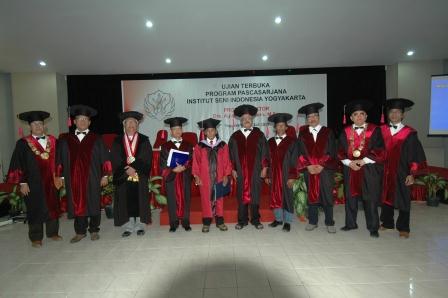
On Thursday, July 2, 2015, the Open Examination of Drs Agus Purwantoro chaired by Prof. Dr. Djohan, M.Si. Promoter Prof. Drs. M. Dwi Marianto, M.F.A., Ph.D. Co Promoter Dr. St. Sunardi and Tester Prof. Drs. Soeprapto Soedjono, M.F.A., Ph.D., Prof. Dr. P.M. Laksono, Dr. G. Subanar, S.J., Dr. GR. Lono Lastoro Simatupang, M.A., Dr. Aris Wahyudi, M.Hum., Dr. Edy Sunaryo, M.S. Mr. Agus Purwantoro successfully defended his dissertation before the Board of Examiners with a Predicate of "Very Satisfactory" Here's a little review of Sikak Sikak Jidor:
The anti-tobacco movement The controversy over tobacco has become a phenomenal issue and has become a major discourse globally and has had an impact on local communities, especially in Indonesia. The various forms of resistance that have emerged, ranging from local farmers, organizers, to state elites and officials, show that the socio-political upheaval that has occurred has not produced a common ground that is a solution to the problem. However, the tobacco community continues to resist through various forms in their communities.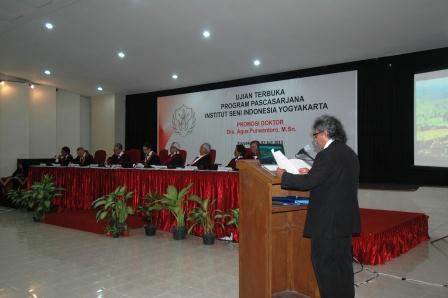 From various studies and studies on the resistance of farming communities, the hypothesis is generated that so far tobacco has only been seen as a trade commodity. The socio-cultural values inherent in the community of the tobacco community itself have not yet become an idea popularized through the field of art creation. Therefore, meaning is needed through art media or alternative art as a place to find records of stories of how the tobacco farming community plays plays and deals with various powers. Through this dissertation, wayang godhonk takes on a role as a medium of awareness/enlightenment towards the nature of living beings in this universe. The ideas and notions in wayang godhonk then become the visualization of the tobacco community in the creation of artworks in this dissertation.
Through ethnographic studies, this approach can provide more insight into the depiction of the visual resistance of tobacco farmers who in the author's interpretation are affected by the power play of global hegemony. In the midst of these conditions and situations, the people (who in this context are tobacco farmers) continue to carry out resistance as a form of resistance to the dominant power. Through various forms of symbolic resistance to open resistance carried out by farmers, it has the meaning of endless struggle. This study observes the resistance of farming communities that is open and tends to be massive and forms of symbolic resistance which then shift into a transgressive resistance to declare themselves challenging the authorities who turn a blind eye to legal and policy injustices. The policy that gave birth to resistance from tobacco communities throughout Indonesia, especially in tobacco farmers in Temanggung, which has a distinctive character in expressing resistance both through the symbolization of material objects, mass actions, demonstrations, traditional arts, and language expressions used.
Some of these works of art creation are a form of artist interpretation of the discourse on the tobacco plant controversy. Tobacco leaves are not only commodity plants but plants that have cultural and artistic values as living things on earth. The view that sees tobacco plants as commodity plants certainly causes the uprooting of cultural and artistic values that have greater power to be appreciated than their commodity value, so what happens is that the exploitation of the tobacco commodity has escaped human wisdom to address its humanity wisely.
Due to the wide and rich diversity of symbols and meanings, the form of artwork produced is not limited to one form of work but follows the creative intuition that can provide enrichment of the art itself. Therefore, this dissertation provides a space for self-actualization through artworks in the form of paintings, godhonk puppet shows, and sculptures. The creation of godhonk puppets in this dissertation is a form of response to society in art that is easily felt and understood by various groups of people. Wayang Godhonk has also become a medium for "srawung" and a more effective means of communicating discourse to various groups. Wayang Godhonk performances become a movement to remind people to return to human spirituality for the benefit of living together by opening discursive spaces to deepen knowledge and get involved in the struggle of the little people to seek justice for the common life.
The title "Sikak-sikak Jidor" is a language or expression that contains a symbolic narrative. In addition to revealing the story behind the turmoil of the tobacco world, it is also an expression of feelings of anxiety and anger in the context of the Temanggung community. The author interprets the symbolic language of "sikak-sikak jidor" as a form of shifting concern from the hustle and bustle of the debate about tobacco to concern about how the tobacco community can stand back on its belief in planting and maintaining tobacco as the tradition they have been doing. This interpretation reveals their resistance to the hegemony of modern power that provokes ordinary people with false beliefs.


 EN
EN  ID
ID