
- Jl. Suryodiningratan No.8 Yogyakarta 55188 Indonesia
- Tel 0274-419791 Fax 0274-419791
- WA +62 858-9008-5880
- pasca@isi.ac.id
S3 Art Study Program Lecture Information
Education Implementation
A. Study Programs and Interests
Based on the Decree of the Minister of Research, Technology and Higher Education of the Republic of Indonesia Number 17/KPT/I/2019 concerning changes in the name of study programs at Institut Seni Indonesia Yogyakarta, the Doctoral Program Art Creation and Assessment Study Program becomes the Doctoral Program Art Study Program. This decision is valid from the date of enactment on January 29, 2019. Currently, ISI Yogyakarta's doctoral program is a Doctoral Program of Art Studies with study interests including art creation and assessment.
B. Study Load, Duration of Study, and Leave Permit
The study load for doctoral education is 42 credits. All of them can be taken in 6-14 semesters. All requirements to complete the doctoral program education to obtain the title Dr. Sn. (Doctor of Arts) must be completed within a maximum of 14 (fourteen) semesters or 7 academic years, whether on leave or not. If the student is unable to complete within this period, or has not passed the qualification exam by the end of the 10th semester, the student is considered incapable and a letter of termination of studies will be issued.
C. Student Status
There are two kinds of student status, namely active and leave.
1. Active Student
To be called an active student, students must pay full tuition fees, and have a student identification card (KTM). Active students are entitled to participate in academic activities, and are allowed to use supporting facilities.
2. Student on leave
Students on leave must obtain approval from the academic supervisor, pay 20% from tuition fees, and are not entitled to participate in academic activities and use available facilities. The maximum leave period is 2 (two) semesters and does not increase the student's study period. Application for leave of absence can be submitted if the student has passed the qualification exam, or can be based on the Manager's discretion authorized by the Postgraduate Director.
3. Absent
Students who do not register without explanation for 30 (thirty) calendar days from the last day of registration will be considered absent. Students who are absent will be considered to have resigned and removed from the list of postgraduate students at ISI Yogyakarta.
D. Switching Interests
Students who intend to change their interest in the middle of the study period must go through a re-evaluation and interview stage to assess their eligibility.
Lectures and Exams
Educational lecture materials in the doctoral program are arranged based on the learning outcomes of the doctoral program 42 credits are mostly used by students to carry out research so that the proportion is:
- Required Courses = 13 credits
- Topic Deepening Course = 4 credits
- Qualification Exam (Proposal Exam) = 5 credits
- Dissertation Research and Writing = 20 credits
- Public Seminar 4 credits
- Eligibility 4 credits
- Final Exam12 credits
Total = 42 credits
A. Assessment System
- Doctoral Program participants can take lecture exams in semesters 1 and 2 if they attend lectures at least 90%.
- Lecture examinations are in written or oral form and are carried out according to the time scheduled in the academic calendar.
- Assessment of learning outcomes is expressed with numbers and letter grades
A | = 91-100 | B- | = 71-74 |
A- | = 87-90 | C | = 60-70 |
BA | = 83-86 | D | = 50-59 |
B | = 79-82 | E | = 0-49 |
B | = 75-78 |
Academic Advisor
Every student has the right to consult with an academic advisor in terms of planning the study process from the first semester until the completion of the study.
B. Mentoring
The dissertation supervisory team consists of a promoter and a copromoter or co-supervisor, but if deemed necessary, another copromoter can be added as a second co-supervisor. Students can submit candidates for Promoters and Copromoters, but the determination will be made by the manager by considering various aspects. The determination of the Promoter Team will be outlined in the Director's decision letter, so that mentoring can be carried out from the beginning of the third semester for the preparation of proposals which will be followed by a qualification examination.
Academic requirements for the main supervisor or promoter are at least a professor, while the copromoter has at least a doctoral degree and or in the case of being the main supervisor, within the last 5 (five) years has produced at least:
- One scientific paper in an accredited national journal or reputable international journal; or
- One other form recognized by a group of experts determined by the college senate.
Promoters and copromoters are preferably from ISI Yogyakarta, but if necessary one of them (promoter or copromoter) can be chosen from another university.
C. Determination of Promoter and Copromoter
- The criteria for determining the promoter/copromoter is based on:
- The suitability of the educational background of the prospective promoter/co-promoter with the dissertation topic;
- The suitability of the promoter/copromoter's publication history with the dissertation topic; and
- Each promoter/copromoter is only allowed to guide a maximum of 10 students (including as promoter and copromoter).
- Promoters and Copromoters who have received a decree will guide regularly starting from the preparation of research proposals / creation of works of art, preparation for qualification exams, conducting research / creation, writing dissertations, evaluating dissertations (feasibility tests), examinations, to preparing for open examinations (doctoral promotion) or attending graduation. In addition, the promoter team also helps students publish research results in reputable international journals according to the provisions of Higher Education.
STAGE OF STUDY
The stages of study in the doctoral program in art creation and study after attending structured lectures for two semesters are qualification exams, public seminars, feasibility assessments, and final exams (closed and open).
A. Qualification Examination
The qualification exam is an exam to test the knowledge and or artistic creativity of doctoral program participants relevant to the field of science or field of art that will be researched for writing a dissertation or artwork to be created.
1. The requirements for taking the qualification exam are:
- Have passed all 1st and 2nd semester courses, with a minimum grade of B in each course, except for Topic Interest courses which can be adjusted according to needs.
- Submit proof of original and photocopy of English language skills issued by the ISI Yogyakarta language center or the ITP TOEFL exam organizing institution with a minimum score of 500.
- Submit an art creation proposal or research proposal to prepare a dissertation in 6 (six) copies no later than two weeks before the examination.
2. The qualifying exam includes:
- Creation/research proposal material
- Mastery of relevant sciences in creation/dissertation
- Qualification examination implementation
- The qualification examination can be taken no earlier than one and a half years (three semesters) after being accepted as a doctoral program participant.
- The examination is conducted by a team of examiners consisting of a chairman (appointed by the director) and members consisting of promoters and copromoters as well as 2 experts in relevant fields of science, with qualifications as professors or those with doctoral degrees as the board of examiners.
- The exam is conducted orally for 120 minutes including a 20-minute presentation of the research proposal or art creation.
- Students who are declared to have passed without improvement, are required to submit a proposal that has been signed by all examiners a maximum of 1 month after the exam. Students who pass with improvements, are required to improve according to the input of the board of examiners between 3 (three) months to a maximum of 6 (months).
3. How the qualification exam is graded
- The assessment is based on the mastery of the exam material, the draft proposal, and the ability to argue academically.
- The decision of the exam result is determined by the board of examiners meeting.
- The results of the exam are pass without correction, pass with minor correction, pass with major correction, or fail.
- Students who are declared unsuccessful have the opportunity to retake the exam only once. The re-examination must be completed no later than the end of the second year of study. The time of the re-examination is determined by the director with a proposal from the promoter and copromoter. Students who do not pass the second time in the qualification examination are declared unable to continue their doctoral program education.
4. Qualification examination result submission
- The result of the examination is delivered by the chairperson of the examination team after the board of examiners has convened.
- The results of the qualifying examination are submitted to the director by the chairman of the board of examiners.
- Doctoral program participants who have passed the qualifying examination and whose proposal revision has been approved by the director obtain the status of doctoral candidate.
- Furthermore, doctoral candidates are required to present the results of the design/research in a public seminar.
B. Dissertation Preparation and Public Seminar
- The dissertation is prepared according to the writing format set by the postgraduate program, written according to good and correct Indonesian language rules and does not contain elements of plagiarism and / or replication.
- Especially for foreign students, the dissertation manuscript is written in Indonesian and has gone through consultation and language correction by a translator/editor whose costs are borne by the student concerned.
- Before being tested at the eligibility examination, the dissertation manuscript must be presented by the doctoral candidate in a public seminar, to determine the progress and results of the guidance. In addition, it is mandatory to attend the ICAPAS international conference as a presenter.
- For public seminars, the material presented must have reached the results, analysis, discussion, and conclusions. The dissertation manuscript has been approved by the promoter and copromoter and known to the department head. The manuscript for the public seminar has also gone through a public pre-seminar stage to check the writing, flow of thought, and presentation material that will be presented in the public seminar. The public preseminar script is collected two weeks before the public seminar. If it has met the requirements of the public pre-seminar, students then carry out the public seminar. Students with an interest in creation studies have realized and exhibited works as an implementation of the concept of creation.
- Doctoral candidates organize public seminars with a minimum of 20 participants including promoters and copromoters. This public seminar is not only attended by students but also practitioners who have been recognized in their fields by the community.
C. Dissertation Eligibility Assessment
- The five eligibility assessors consist of the chair, promoter, copromoter, and two assessors who can be proposed by the supervisory team. Proposed names of eligibility assessors from the supervisory team will be proposed and the final decision is determined by the graduate program manager.
- The feasibility assessment can only be carried out and produce a decision, if attended by at least 4 assessment members including the supervisory team.
- The feasibility assessor is tasked with providing corrections, input, improvements to the submitted manuscript, and declaring it feasible, not feasible, and not feasible.
- The assessment material includes the overall substance of the artwork/research and scientific methodology.
- Students must be able to prove that the manuscript passes the plagiarism test with a tolerance level below 20%.
- The improvement notes outlined in the dissertation must be approved by all members of the feasibility assessment as evidenced by filling out the feasibility assessment minutes sheet. The supervisor team signs the approval sheet as a result of the feasibility assessment evaluation process, after the other members of the assessment team sign.
- The minutes of the improvement of the dissertation assessment must be attached to the application for the closed final examination.
- There are 3 (three) dissertation assessment decisions, namely: Feasible without improvement or feasible with improvement given 3 months, Not feasible, with improvement given a maximum of 6 months, Not feasible.
- If declared eligible or eligible with improvements, then within a maximum of 3 months, doctoral candidates can register to take the closed examination.
- If declared unfit, the dissertation must be corrected within a maximum of 6 months. If within that time the doctoral candidate is unable to complete the repair, a reassessment will be held.
- If declared ineligible, the dissertation must be corrected within a maximum of 6 months, and a re-assessment is held.
- All academic administration fees for reassessment exams are charged to the students concerned.
D. Final Exam
1. Closed
- The closed examination is held no earlier than the 6th semester and no later than the 14th semester.
- For the closed examination, submit a manuscript that has been published in printed form by 2 nationally accredited journals (at least Sinta 2) or at least 1 international equivalent journal (IJCAS or other indexed international journals) published during the study period.
- The closed examination consists of 7 (seven) people and is chaired by the director of the postgraduate program or the chief examiner appointed by the director of the postgraduate program.
- The closed examination for the interest in creation studies begins with the presentation of the promovendus' artwork in front of the examining team in the form of a performance / exhibition of works within 60-120 minutes, followed by a closed examination session.
- Any decision to conduct the exam is determined by the manager after prior discussion with the supervisory team.
- For the implementation of off-campus exams, related to accommodation, travel / flights, must comply with SBU / Ministry of Finance standards.
- The venue for the examination must be in accordance with the procedures for examinations/test performances on the Postgraduate campus.
- The Board of Examiners can decide the promovendus not to go through the open stage with the criteria:
- Successfully publish SCOPUS-level International Journal with promoter/promoter team, or
- Produce a monumental work, exhibition or performance that is judged to be equivalent to the open stage.
2. Open
- The open examination is held a maximum of 3 months after the closed examination. If it is not held without a clear reason, the closed examination must be repeated, and all academic administration costs are borne by the promovendus.
- The open exam is held once. The exam assessment includes mastery of the material, as well as attitude and academic ethics.
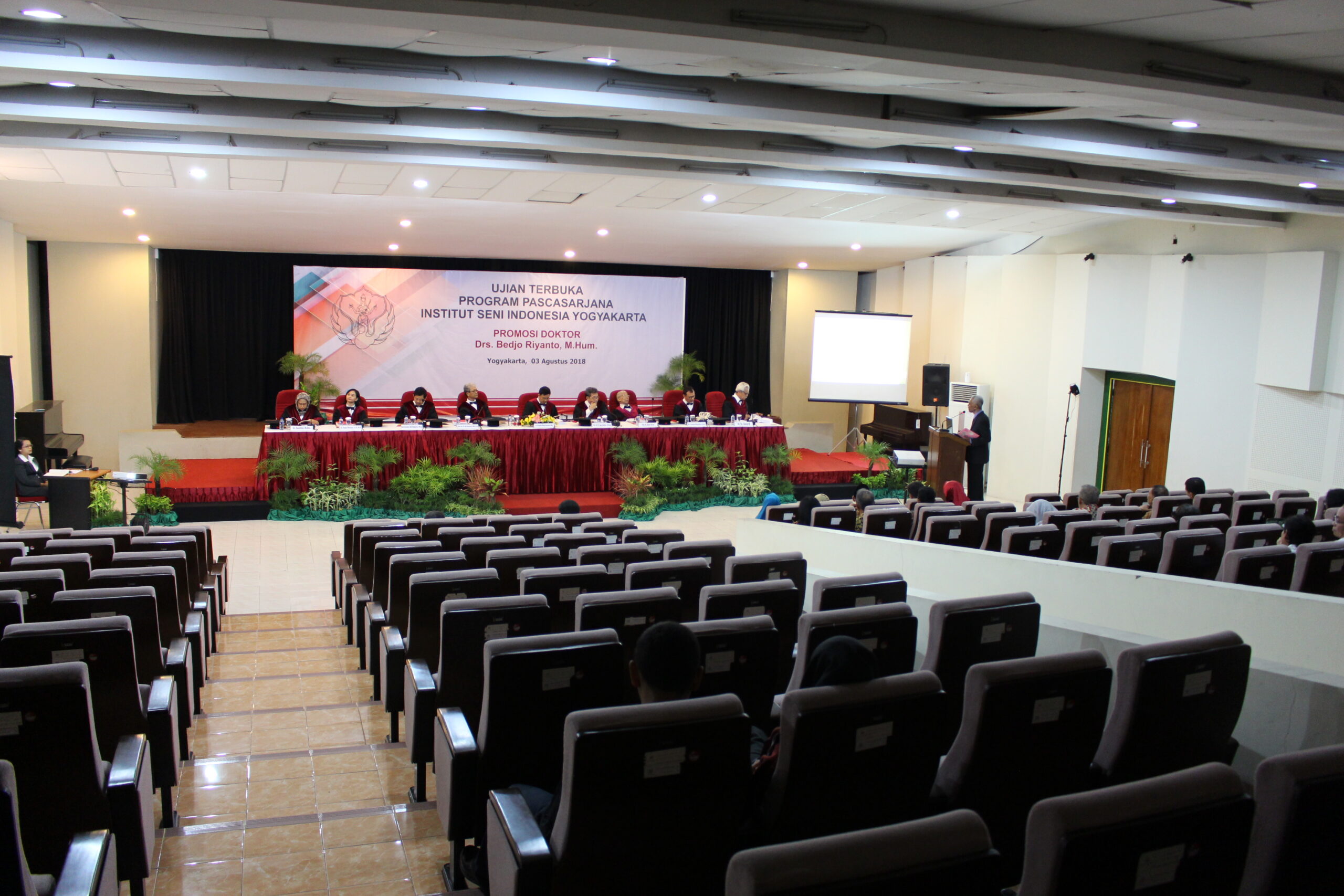
- The open examination is conducted by an assessor consisting of 9 (nine) members, including the chairperson, promoter, and copromoter. The open examination can be held if at least 7 (seven) people including promoters and / or copromoters are present.
- Open examinations are chaired by the graduate program director or a substitute appointed by the graduate program director.
- Open examinations are attended by invitees who are limited to those who can absorb the field concerned.
- No later than 2 (two) weeks before the open examination, the dissertation, dissertation summary, and administrative requirements for the completeness of the open examination must have been received by the postgraduate program.
- The examiner's attire is a toga with a white collared shirt top with a black bow tie.
- The promovendus' attire is full civilian clothes (men) and blazer (women).
- The timing of the promotion examination is determined by the graduate program and the examination is held for a maximum of 120 minutes in the form of a dissertation summary presentation.
- Determination of the title of graduation is based on the closed examination score and the ability to defend the dissertation before the open examination examiner team.
E. Graduation predicate
The predicate of graduation is the student's GPA score after passing the final examination, with the following details:
- Satisfactory: 3,00-3,50
- Highly Satisfactory: 3,51-3,74
- Cum laude: 3,75 <
The cum laude predicate is given to students who take a study period of no more than eight (8) semesters. Very satisfactory predicate is given to students who take no more than fourteen (14) semesters of education. A certificate of graduation predicate is given at the time of the open examination. Diplomas signed by the director of the postgraduate program and the rector will be given if the prerequisites for taking a diploma have been fulfilled.
F. Graduation
Graduation is taken by students who do not take an open examination. The requirement to take graduation is to fulfill all graduation requirements and submit an ISBN dissertation publication book as a substitute for the open stage in accordance with the provisions set by the art study program of the ISI Yogyakarta postgraduate doctoral program.
EDUCATION EVALUATION
A. Evaluation of Study Results
There are three evaluations of the study progress of doctoral program participants, namely:
- The first evaluation is conducted at the end of the first year. At the end of the first year students must pass a minimum of 12 credits. If they do not fulfill these provisions, then students are declared unable to participate in studies at the ISI Yogyakarta postgraduate program and a letter of termination of studies will be issued.
- The second evaluation is conducted in the second year. If at the end of the second year the student has not passed the qualification exam, the student is declared unable to continue his/her studies at the ISI Yogyakarta postgraduate program and a letter of termination of studies will be issued.
- The third evaluation is conducted in the seventh year. If at the end of the seventh year students have not passed the closed examination, they will be declared unable to continue their studies at the ISI Yogyakarta postgraduate program and a letter of termination of studies will be issued.
B. Certificate Retrieval Requirements
- Submit a dissertation that has been improved by considering the input, refutation, and suggestions of the assessors during the open examination, in triplicate with a thick cover (hard cover) and has been signed by the assessment team.
- Submit the dissertation in the form of Soft copy.
- Collect publication manuscripts in the form of hard copy and Soft copy.
- Have completed all administrative requirements and obligations at the ISI Yogyakarta postgraduate program.
- Collect 6 (six) 3x4 color passports, with a color background
- At least 2 keepsake books for the library according to the field of science equivalent to S3.
C. Plagiarism
Plagiarism is a serious offense in academia because it makes truth and the examination of truth difficult or impossible. Plagiarism is the taking of someone else's ideas/writing as one's own. If found plagiarizing, students who commit this offense can be subject to sanctions in the form of: not passing the course, not passing the dissertation exam, or being expelled from the ISI Yogyakarta postgraduate program.
D. Other
Other provisions that have not been listed in this academic handbook will be regulated in separate provisions by the postgraduate program. All changes apply in accordance with the latest academic handbook.
 EN
EN  ID
ID